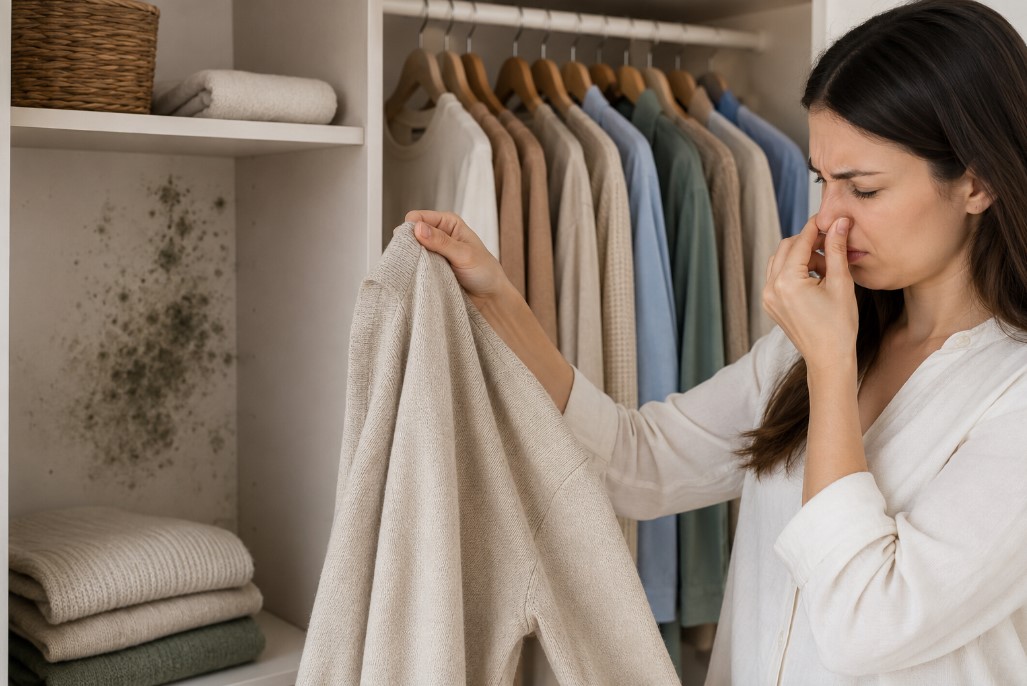
Musty-smelling clothes from your closet almost always come down to one thing: mold or mildew quietly growing in a humid, poorly ventilated space. The good news — you can fix it today without buying expensive products.
Quick Answer
- Musty smell = mold or mildew spores feeding on moisture and organic matter (skin cells, detergent residue)
- Rewash affected clothes with white vinegar or oxygen-based bleach — skip the fabric softener
- Wipe down closet walls and shelves with diluted white vinegar (1:1 with water), then dry completely
- Place activated charcoal or baking soda inside the closet as an ongoing odor absorber
- Never store damp or even slightly wet clothes — this is the #1 cause
- If the smell keeps coming back, the problem is the closet itself, not the clothes
Why Do Clothes in Your Closet Smell Musty?
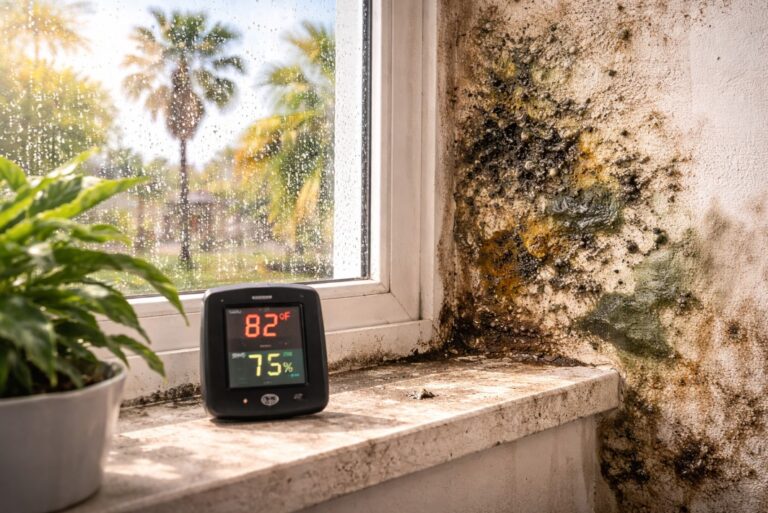
Mold and mildew grow whenever relative humidity stays above 60% in an enclosed space — and a closed wardrobe with poor airflow is basically a perfect incubator. It’s not just about water leaks or obvious dampness. Even the moisture from freshly showered skin, slightly damp laundry, or humid summer air is enough.
Here’s what’s actually happening at a microscopic level: mold spores (which are always present in indoor air) land on fabric and begin colonizing organic material — dead skin cells, body oils, detergent residue left in fibers. Once a colony forms, it releases microbial volatile organic compounds (MVOCs), which create that distinctive musty, earthy odor.
A few things accelerate this:
- Closed closet doors 24/7 — traps moisture with nowhere to escape
- Clothes packed tightly — zero air circulation between garments
- Wooden shelves and walls — wood absorbs moisture and holds mold longer than plastic or metal
- Basement or ground-floor closets — naturally higher humidity levels
- Storing clothes unwashed after wear — body oils and sweat are food for mold
And here’s the thing I see people miss most often: they rewash the clothes but never treat the closet itself. The smell comes back within days because the source is still there.
Step-by-Step: How to Remove Mildew Smell from Clothes
White vinegar is your first move — it’s acetic acid, which disrupts mold cell membranes and neutralizes odor-causing MVOCs at the same time. Add 1 cup of distilled white vinegar directly to the drum of your washing machine and run a normal cycle with warm water. Skip fabric softener — it coats fibers and can trap odors further.
For light musty smell:
- Add 1 cup white vinegar to the wash drum (not the detergent dispenser)
- Use your regular detergent as normal
- Wash on the warmest setting safe for that fabric
- Dry completely — outdoors in sunlight if possible (UV kills mold spores)
- Don’t fold and store until fully dry — touch the thickest seams to check
For stronger or visible mold on fabric:
- Take the item outside before bringing it inside — brushing off visible mold indoors spreads spores
- Pre-soak in a solution of oxygen-based bleach (OxiClean or similar) for 30–60 minutes
- Wash with detergent + ½ cup baking soda to boost odor neutralization
- Check before drying — heat from a dryer can set stains permanently
- Repeat if needed before drying
| Smell Level | Treatment | Avoid |
|---|---|---|
| Faint / just stored too long | White vinegar in wash | Fabric softener |
| Moderate musty odor | Vinegar + baking soda wash | Hot dryer before smell is gone |
| Strong / visible mold spots | Oxygen bleach pre-soak + wash | Chlorine bleach on colored fabric |
| Smell persists after 2 washes | Professional dry cleaning | Storing again without fixing closet |
For a deeper dive into fabric-specific treatment methods, this guide on how to get mould out of clothes covers additional techniques for delicate and specialty fabrics.
One thing worth knowing: chlorine bleach kills mold but damages most fabrics and sets some stains. Oxygen-based bleach is gentler and works on colors. For wool, silk, or dry-clean-only items — take them to a professional and mention the mold issue specifically.
How to Clean a Musty Smelling Closet
Before putting clean clothes back, the closet itself needs to be treated — otherwise you’re solving the wrong problem. Empty everything out first. Yes, everything.
Closet cleaning process:
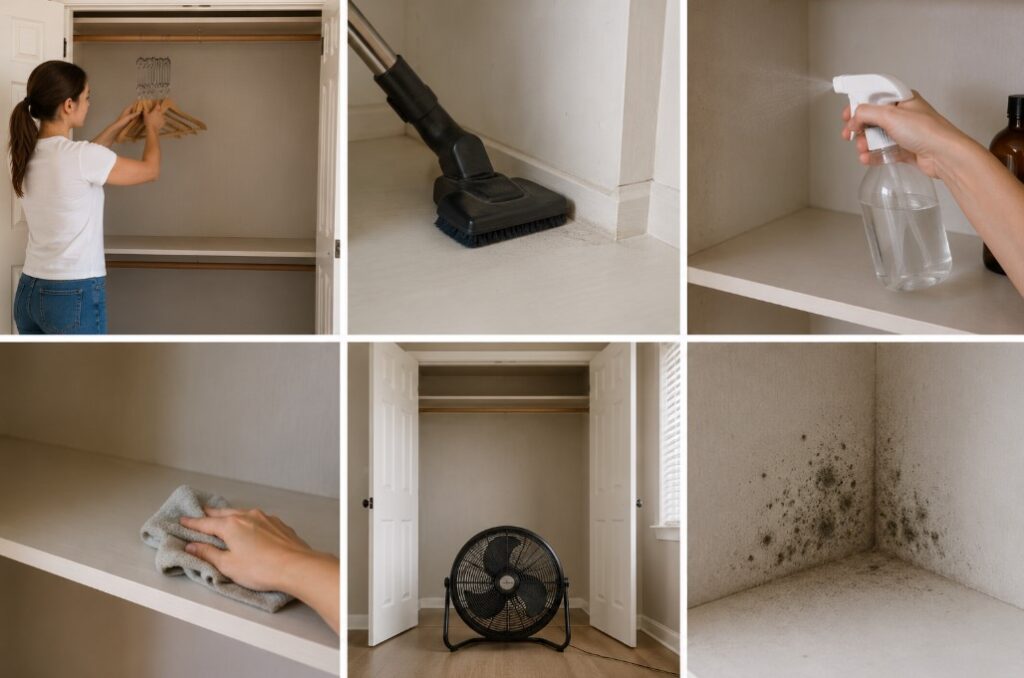
- Vacuum all surfaces — shelves, walls, floor, ceiling corners. Use a HEPA filter vacuum if you have one; standard vacuums can recirculate spores.
- Wipe down with diluted white vinegar — mix 1 part vinegar to 1 part water in a spray bottle. Spray all wood surfaces, walls, and shelves.
- Let it sit for 10 minutes, then wipe dry with a clean cloth.
- Leave the closet open with a fan directed inside for 6–12 hours. This step gets skipped and it shouldn’t — surfaces need to be genuinely dry before clothes go back in.
- Check for visible mold — black, green, or white fuzzy spots. If you find significant mold growth on walls (more than a few small patches), that goes beyond a DIY wipe-down.
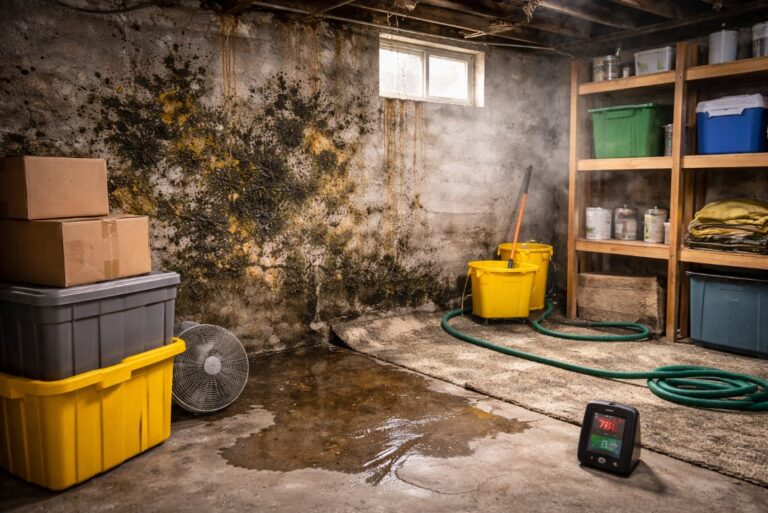
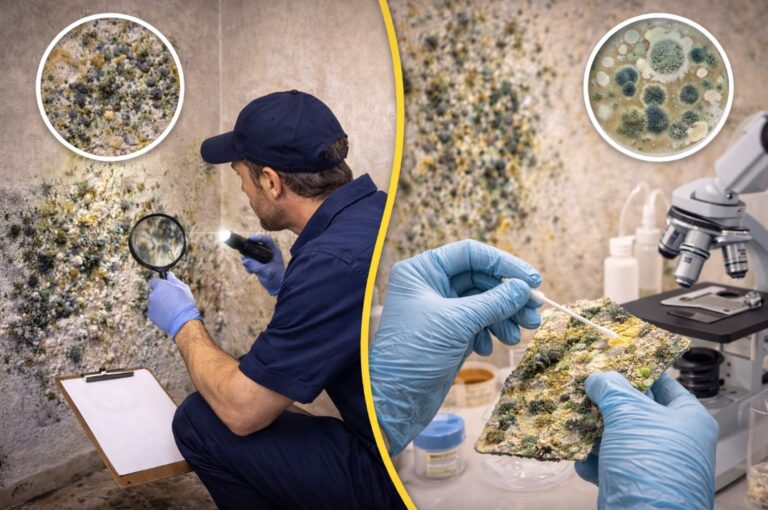
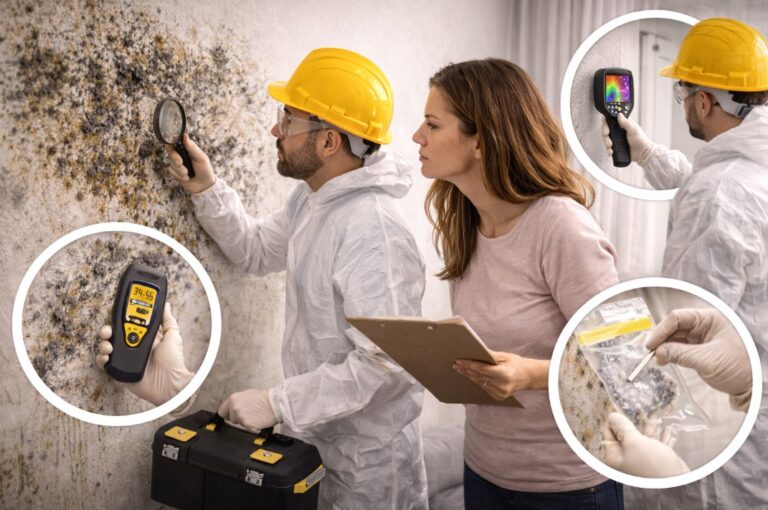
If you’re dealing with recurring mold on closet walls, or the musty smell comes back within a week of cleaning, that suggests a moisture problem inside the wall structure or a humidity issue in the room itself. At that point, the situation is similar to what mold remediation professionals in humid climates handle regularly — the visible mold on the surface is often just a symptom of moisture trapped inside the wall cavity. Resources like mold inspection guidesexplain what professional assessment covers if you’re concerned about deeper contamination.
Natural Remedies & Absorbers
Activated charcoal is the most effective passive odor absorber — it works through adsorption, meaning it chemically binds odor molecules to its porous surface rather than just masking them. A small bag of activated charcoal (100–200g) placed on a shelf will absorb moisture and neutralize MVOCs continuously for 1–2 months before needing to be recharged in sunlight.
Other options that genuinely work:
- Baking soda — open box or small cloth pouch on a shelf. Absorbs odors well, less effective on moisture. Replace monthly.
- Cedar blocks or cedar hangers — cedar oil repels moths and has mild antimicrobial properties. Effective for prevention, not for eliminating an existing smell.
- Dried lavender sachets — masks odor rather than neutralizing it, but pleasant and useful alongside other methods.
- Silica gel packets — excellent for moisture control in small enclosed spaces, especially for seasonal storage boxes.
What doesn’t work as well as people think: dryer sheets placed in closets. They mask odor temporarily but do nothing about moisture or mold — and the fragrance fades within days.
What Health Guidelines Say About Mold Exposure
This is where it’s worth being precise rather than alarming. The EPA, CDC, and WHO acknowledge that mold exposure can cause health effects, but the severity depends on the amount, species, individual sensitivity, and exposure duration.
- The CDC notes that mold can cause nasal stuffiness, throat irritation, coughing, eye irritation, and skin irritation in sensitive individuals
- People with asthma, allergies, or compromised immune systems are at higher risk from mold exposure
- The EPA recommends that any mold covering more than 10 square feet be handled by a professional
- Stachybotrys chartarum (black mold) is often the concern in homes — but most closet mold is Cladosporium or Aspergillus, which are less toxic though still problematic at sustained exposure
- Washing mold-affected clothing outdoors reduces indoor spore dispersal
- There are no established federal standards for acceptable indoor mold levels — any visible growth is considered worth addressing
Disclaimer: If you or a household member experiences persistent respiratory symptoms, consult a physician. This article addresses surface-level mold on clothing and closets — it is not medical advice, and is not a substitute for professional mold assessment in cases of significant structural contamination. For suspected black mold or large-scale growth, professional evaluation from a licensed remediation service is the appropriate next step. You can learn about what professional black mold removal involves before deciding whether you need it.
Prevention: Keep Clothes Smelling Fresh Long-Term
The single most effective prevention habit is simple: never put even slightly damp clothing back into a closed closet. That includes clothes that feel dry to the touch — if it’s been worn for a full day, there’s body moisture absorbed into the fibers. Air garments out on a hook or chair back overnight before returning them to the closet.
Beyond that, the goal is to keep closet humidity consistently below 60%:
- Leave closet doors open for 15–30 minutes daily — especially in summer or after showering in a nearby bathroom
- Use a small hygrometer (under $10) to monitor closet humidity — if it regularly reads above 60%, add an absorber or small dehumidifier
- Don’t overfill — clothes need at least a finger-width gap between hangers for air to move
- Wash seasonal items before storing — even “clean-looking” clothes have body oils that attract mold during months of storage
- Check the closet after heavy rain — ground-floor and basement closets can see humidity spikes after precipitation
One thing I’ve noticed makes a real difference: pulling the closet away from exterior walls slightly, or adding a small clip fan to run for an hour a day. Static air is the enemy here.
Special Case: Seasonal Clothes in Storage
Seasonal clothes stored in sealed plastic bags or airtight bins are a common cause of musty smell — and the logic seems counterintuitive at first. The problem is that no fabric is 100% dry when it goes in. Sealed storage traps residual moisture with no way to escape, creating the exact humid microenvironment mold needs.
What to use instead:
- Breathable fabric storage bags — allow vapor exchange while keeping dust and pests out
- Cotton or canvas bins — much better than plastic totes for long-term fabric storage
- Silica gel packets inside containers — if you do use plastic, add 2–3 large silica packets per bin and replace them yearly
What to do before storing:
- Wash everything, even items worn only once
- Dry fully — run through the dryer on low for 20 minutes even if line-dried
- Let cool completely to room temperature before folding — warmth creates condensation inside storage
- Add cedar blocks or activated charcoal sachets inside each bin
For long-term storage of wool, cashmere, or vintage pieces, clean storage and breathable garment bags are non-negotiable. These fabrics are especially susceptible to both mold and moth damage.
Frequently Asked Questions
Why do my clothes smell musty after being in the closet even though I washed them?
The closet itself has mold or elevated humidity that recontaminates clean clothes. Washing clothes without addressing the closet environment means the smell returns within days. Clean and dry the closet before returning laundered items.
Can musty-smelling clothes make you sick?
Prolonged exposure to mold-contaminated clothing may cause irritation in sensitive individuals — particularly those with allergies, asthma, or weakened immune systems. For most people, occasional exposure is low-risk, but recurring musty clothes warrant investigating the closet for mold growth.
Does washing clothes get rid of mold?
A regular wash cycle alone often doesn’t fully eliminate mold or its smell. You need either white vinegar, oxygen-based bleach, or baking soda added to the wash, along with thorough drying (ideally in sunlight) to break down mold colonies and neutralize MVOCs.
What absorbs musty smell in a closet fast?
Activated charcoal bags work fastest and most effectively — they start adsorbing odor molecules immediately. Baking soda is a slower alternative. Both work best after the closet has been cleaned; absorbers can’t compensate for an active mold source.
How do I know if it’s mold or just a stale smell?
Mold smell is distinctly earthy, musty, or like wet soil — often described as resembling old books or a damp basement. Stale smell (from old fabric or non-circulation) is flatter and less sharp. If the smell is accompanied by visible spots on clothing or closet surfaces, it’s mold.
Can I use bleach to clean a closet with mold?
Diluted bleach (1 cup per gallon of water) kills surface mold on non-porous surfaces like painted walls or plastic. On wood — which most closet shelves are — bleach doesn’t penetrate deep enough and the mold often returns. White vinegar or an enzyme-based cleaner is more effective on porous wood surfaces.
How often should I clean my closet to prevent mold?
A thorough wipe-down of shelves and walls twice a year (spring and fall) is a reasonable baseline. If your home is in a humid climate, or you’ve had mold issues before, quarterly cleaning and year-round use of moisture absorbers is more appropriate.
If the musty smell in your closet keeps coming back despite cleaning — or you’re finding mold on walls, not just clothes — it’s worth having a professional assess whether there’s a moisture issue behind the wall structure. For homeowners in Southern California, RL Lifestyles’ partners at moldrm offer mold remediation assessments that identify the source rather than just treating symptoms.